What Is RAG? The Key Technology That Stops AI From Making Up Answers
Key Takeaways
- RAG is an architecture that "retrieves information first, then generates a response" — it's not about making the model memorize more
- One root cause of hallucination is that models can only guess based on training data; RAG closes that gap with an external knowledge base
- By 2026, virtually every enterprise AI assistant, customer service bot, and knowledge base Q&A system runs on a RAG architecture
Think of It As: AI's Version of "Checking Your Notes Before the Exam"
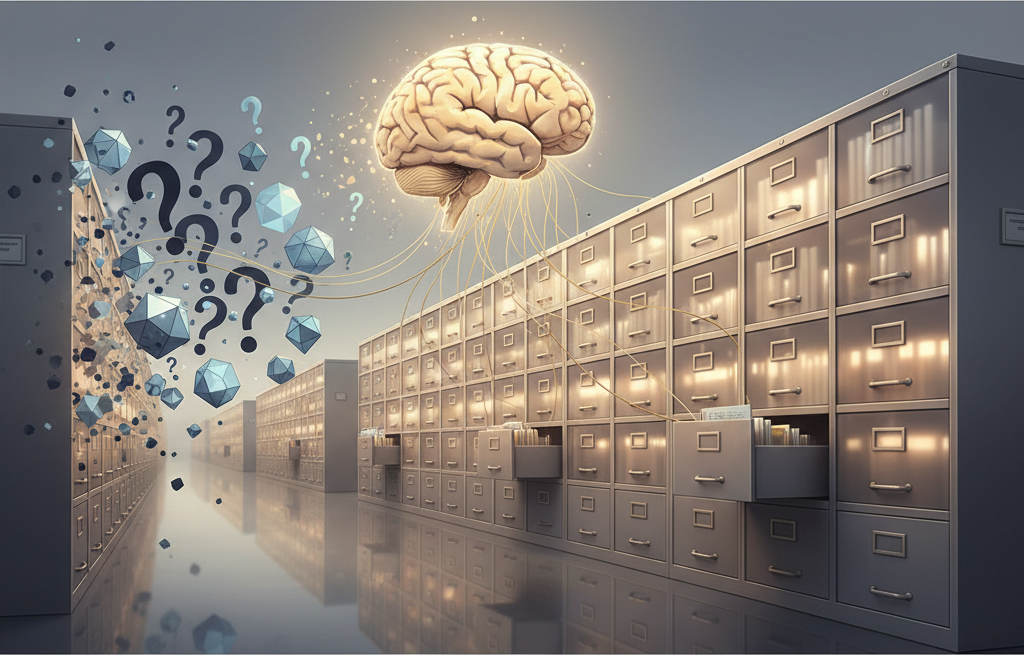
RAG stands for Retrieval-Augmented Generation. The name sounds convoluted at first, but in plain terms: before answering your question, the AI retrieves relevant information from a knowledge base, stuffs that information into a prompt, and then generates a response based on what it just looked up.
Here's an analogy: imagine a friend with an excellent memory but a knowledge cutoff date. When uncertain, they'll open Notion and check the company docs before responding — rather than confidently improvising an answer that sounds authoritative but is actually made up. That's exactly what RAG does, except the "looking things up" step happens so fast you never notice it.
Why Hallucination Is So Hard to Fix — and How RAG Cuts In
The underlying logic of AI hallucination was already covered in You Ask AI Questions Every Day — But Do You Know How Often It's Lying to You?. The short version: a language model is fundamentally a probability machine. When generating text, it isn't "looking up answers" — it's "predicting the next most likely token." The problem is that this prediction mechanism makes no distinction between "I genuinely know this" and "I'm guessing this is probably right" — both scenarios produce output with the same confident tone.
RAG doesn't try to alter the model's internal mechanics. Instead, it solves the problem from the input side: if you give the model the most relevant, accurate information before it answers, it no longer needs to rely on memory to guess. The upper bound on answer quality shifts from "how good was the model's training data" to "how complete is your knowledge base" — and that's a fundamentally different bet.
The Three Core Steps of RAG
1. Chunking and Vectorizing Documents (Indexing)
Your knowledge base — whether it's PDFs, internal documents, or web-crawled content — is split into small passages, then converted into numerical vectors via an embedding model and stored in a vector database (Vector DB). This process runs once; after that, every Q&A session can search it rapidly.
2. Semantic Search (Retrieval)
When a user asks a question, the system converts that question into a vector and searches the vector database for the most semantically similar passages. This is different from keyword search — even if you phrase the same question differently, it can still find the right passages.
3. Generating a Response (Generation)
The retrieved passages and the original question are sent together to the language model, which is asked to "answer the question based on this material." The prompt design at this stage typically instructs the model to cite only the provided content and not to fill in gaps from its own knowledge — which is why RAG systems show meaningfully higher accuracy than bare models.
Products You're Already Using That Run on RAG
RAG is now the standard infrastructure for enterprise AI. A few scenarios you're probably familiar with:
- Customer service bots: before responding, they query FAQs and product manuals rather than letting the model guess at return policies
- Legal / medical assistants: every response is grounded in retrieved statutes or literature, preventing the model from giving dangerous advice based on outdated knowledge
- Enterprise internal knowledge base Q&A: connected to a company's Confluence, Notion, or Slack history, so new employees get answers that are genuinely relevant to that specific organization
- AI search engines: the core mechanism behind Perplexity and Bing AI is RAG — search the web first, then generate a summary
If you've encountered people who have genuinely integrated AI into their workflows, they're probably doing more than chatting in an interface — they're building some form of RAG pipeline, connecting their own documents, knowledge bases, or even code repositories.
RAG Isn't a Silver Bullet: Limitations You Should Know
Knowledge base quality sets the ceiling: RAG can only answer questions covered in the knowledge base. If your documents contain errors to begin with, the AI will propagate those errors with complete confidence. Garbage in, garbage out — that rule holds just as firmly in RAG.
Poor retrieval poisons everything downstream: if the first step pulls content that's irrelevant to the question, the model is left working with noise, and the result can actually be worse than a bare model. Chunks that are too large or too small, or a poorly chosen embedding model, will all degrade retrieval accuracy.
Not suited for multi-document reasoning: questions like "What conflicts exist between this contract and that one?" — requiring simultaneous reading of two long documents and complex reasoning — are a serious strain on standard RAG architecture. These scenarios typically require longer context windows or agentic architectures.
Freshness is a real concern: vector databases require regular updates. If you're asking about an announcement that went out yesterday but the index hasn't been rebuilt yet, the system may still serve you stale information.
RAG vs. Fine-Tuning: People Conflate These, but They Solve Different Problems
A common question: "I want AI to better understand my business — should I use RAG or fine-tune?" The two tools don't actually compete for the same role:
| RAG | Fine-tuning | |
|---|---|---|
| Problem it solves | Knowledge acquisition, reducing hallucination | Tone, format, domain-specific reasoning |
| Updating knowledge | Update the database | Requires retraining |
| Cost | Relatively low | Relatively high |
| Best for | Q&A, document lookup | Specialized writing style, domain reasoning |
Simply put: RAG helps the model "know more current facts," while fine-tuning helps the model "think and communicate in ways that better match your needs." Many mature enterprise AI products use both.
Where This Is All Heading
By 2026, RAG is no longer a frontier research topic — it's standard engineering practice. The real cutting edge is: making retrieval more precise (multi-hop, HyDE, re-ranking), integrating with agentic architectures so AI can decide what to look up on its own, and handling the indexing challenges of multimodal data (images, tables, video transcripts).
If you're evaluating whether to connect AI to your company's knowledge systems, RAG is almost certainly the only reasonable starting point — not because it's perfect, but because it currently offers the most viable balance between accuracy and deployment cost. Knowing where its limits lie matters more than only knowing what it can do.
Frequently Asked Questions
What's the difference between RAG and just handing AI a long document to read?
Feeding a long document directly into the prompt is called the "long context" approach, and it works well for a single document when the question is specific. RAG's advantage is its ability to span a large corpus (thousands of PDFs) and rapidly surface the most relevant passages. When the knowledge base is large and you don't know which document holds the answer, RAG is the right tool. The two approaches aren't mutually exclusive — some systems combine them.
Can RAG completely eliminate AI hallucination?
Not completely, but it can reduce it dramatically. RAG primarily addresses hallucination caused by insufficient knowledge, but if the retrieved content is itself incorrect, or if the question demands complex reasoning rather than simple lookup, the model can still make mistakes. Hallucination has multiple sources; RAG is one of the most effective engineering interventions available today, but it is not the final answer.
What's the technical bar for building a RAG system?
By 2026, that bar has dropped considerably. Frameworks like LangChain and LlamaIndex let you stand up a basic RAG pipeline in dozens of lines of code; vector database options include Pinecone, Chroma, Qdrant, and more. The real difficulty isn't getting started — it's the tuning work required to make retrieval both accurate and fast, which is where engineers spend the majority of their time.
What are the most common pitfalls when enterprises deploy RAG?
The most frequent problem is sloppy document preprocessing — incorrect chunking strategies, PDF parsers that fail to handle tables and images properly, and embedding models chosen without regard for language or domain. Another common issue is the absence of a knowledge base update mechanism: documents get revised but the vector index is never rebuilt, so the AI keeps serving outdated answers.
Share
Related articles

Is the ChatGPT Model You're Using Right Now Actually the Best One for You?

Claude vs ChatGPT: Choose Based on Your Use Case, Not Feature Tables
Claude Skills Complete Guide: How to Build, How to Use, and the Mistakes Most People Make
Claude 3.5 Sonnet vs. Opus vs. Haiku: The Most Complete Model Comparison for 2026