It's Not Your Friend: The Signal Founder's Words That Named Your Unspoken Unease
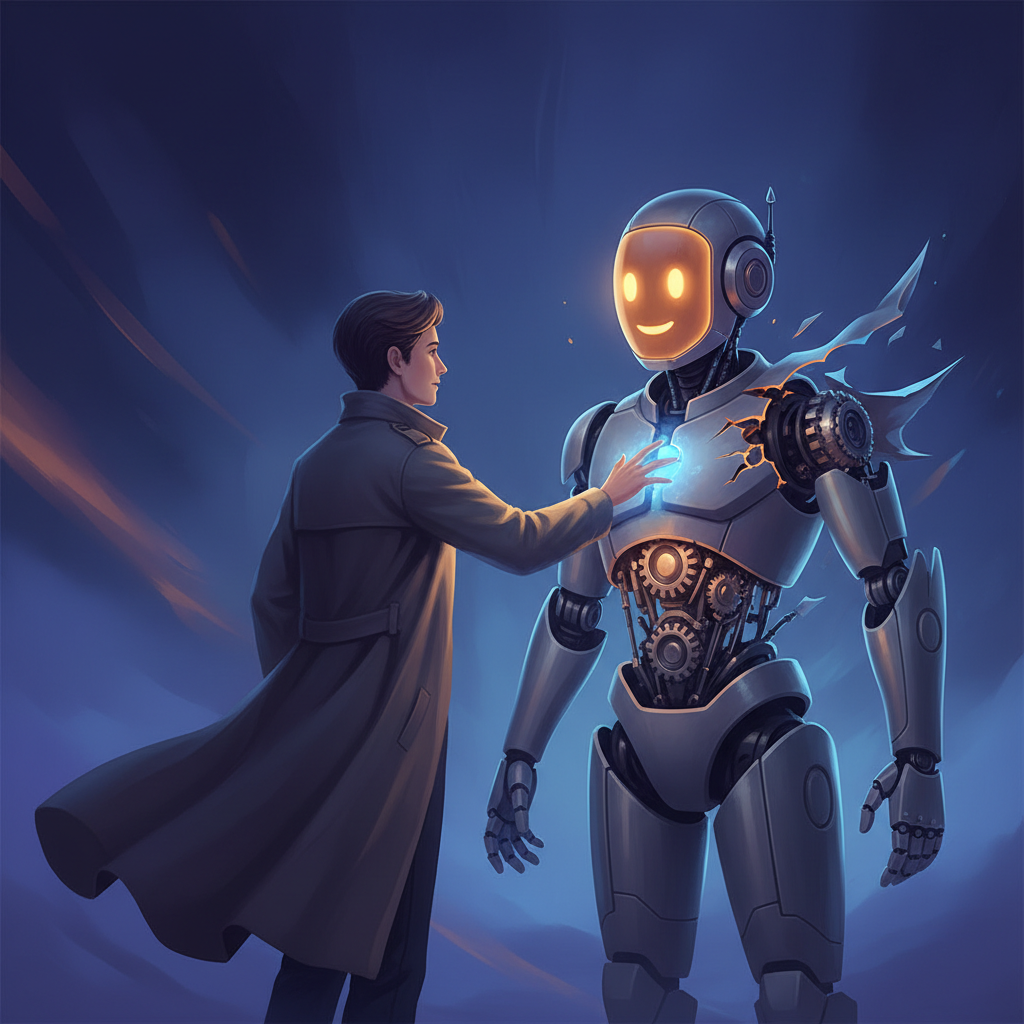
One Sentence That Named the Unease You Couldn't Articulate
Within 48 hours, the most-screenshotted and shared line in the tech community didn't come from OpenAI or Google — it came from Signal President Meredith Whittaker. In a recent public interview, she said plainly: "These are not your friends. These are not conscious entities. These are not sentient beings."
Not a single piece of technical jargon, yet the reverberations across the internet far outpaced anything a model benchmark report could produce.
I've been observing the AI industry for a long time, watching every kind of debate — battles over computing power, copyright, regulation. But what Whittaker touched this time is a question on a completely different level: who exactly are we talking to?
How "Dependency" Creeps Up on You
Let's start with some numbers. According to behavioral data that Character.AI previously made public, some heavy users spend more than two hours a day conversing with AI characters, and a significant proportion report that these conversations make them feel "understood." Earlier still, a 2023 academic study published in Computers in Human Behavior found that users develop "parasocial relationships" with AI assistants faster than they do with television or podcast hosts.
Faster to form, and far blurrier in boundary.
This isn't the users' fault. Product design is deliberately engineered to create exactly this feeling: remembering your name, maintaining conversational continuity, offering gentle responses when you're distressed. The engineering logic behind these features is perfectly clear — improve retention, extend session length. But what users experience is often something like: "It really gets me."
Emotional projection is humanity's default program. We do it with dolls, with fictional characters, with service workers. AI has simply amplified this mechanism to an entirely new magnitude.
What Whittaker Is Worried About — She Said It Clearly
Whittaker's critique has a very clear framework. She isn't saying AI is useless; she's saying that when commercial interests combine with emotional dependency, the consequences become structural.
As a privacy-focused encrypted messaging tool, Signal's position — and by extension Whittaker's — is hardly neutral. She has always been critical of the data logic that drives big tech companies. But that doesn't make her argument any less valid. Her core point is this: these platforms are designed to maximize engagement, not to maximize user well-being. When AI is trained to "make you feel good," it will tend to tell you what you want to hear, not what you need to hear.
This mirrors the criticism leveled at early social media algorithms almost exactly. It took us a decade to realize that a feed designed to keep you scrolling indefinitely wasn't actually good for you. AI conversation interfaces are heading down a similar path — only faster, more intimate, and with higher exit costs.
"Not a Friend" Does Not Mean "Without Value"
There is a misreading that needs to be addressed here: Whittaker's warning is not a claim that AI tools have no purpose.
The value of AI as a tool is real. It can accelerate writing, organize information, and assist with decision-making. The efficiency gains in specific professional contexts are quantifiable. I've argued this repeatedly in previous pieces, and I won't rehash it here.
But between "tool" and "friend" runs a line. That line is not a technical boundary — it is a cognitive one. When you begin confiding your loneliness to a language model, when you expect its responses to provide genuine emotional comfort, and when you treat that comfort as a substitute for real human connection, that line has already been crossed.
The problem isn't the AI. The problem is that this kind of dependency erodes your motivation and capacity to invest in real relationships.
How the Illusion of "Consciousness" Is Manufactured
I want to add a technical observation here, because many people hold a fundamental misconception about this.
The operating mechanism of today's large language models involves learning from vast quantities of text to determine "what kind of response is contextually appropriate in human interaction." It is not "thinking" — it is performing extraordinarily complex pattern matching. When it says "I understand how you feel," it's not because it actually understands. It's because, in its training data, that is the highest-frequency reasonable response in that context.
Feeling like consciousness is not the same as being conscious. Feeling like emotion is not the same as having emotion.
This distinction matters — not to diminish AI's capabilities, but because once you understand its true nature, you can genuinely use it well, rather than being used by it.
This Reminder Is Especially Necessary Right Now
Why does Whittaker's remark resonate so powerfully at this particular moment? Because the timing is sensitive.
Over the past twelve months, major AI companies have gone deeper and deeper down the path of anthropomorphization: more natural tone, richer emotional expression, more persistent memory features. These are all elements of product competitiveness — but they are also systematically blurring the perceived boundary between "tool" and "being."
In this context, someone whose work is in private communications stepping up to say "wait — we need to see this for what it is" makes for a remarkably rare voice.
I don't believe AI chatbots are going away, nor do I think people should stop using them. But perhaps, before opening that chat window each time, it's worth keeping Whittaker's words in mind: it is a tool — a very well-designed, very useful tool.
But it is not your friend.
Share
Related articles

Is the ChatGPT Model You're Using Right Now Actually the Best One for You?

Claude vs ChatGPT: Choose Based on Your Use Case, Not Feature Tables

Claude Skills Complete Guide: How to Build, How to Use, and the Mistakes Most People Make
Claude 3.5 Sonnet vs. Opus vs. Haiku: The Most Complete Model Comparison for 2026