The Real Crack in the OpenAI Leak: Not Cybersecurity, But 'Who Controls These Models'

A few weeks ago, someone posted a screenshot on social media — an OpenAI private Hugging Face repository token had accidentally been exposed in public code, potentially allowing outside parties to access model weights or related resources that were never meant to be public. The moment the news broke, the AI safety community on Twitter erupted.
The technical side of this incident isn't complicated: a secret wasn't managed properly, and someone picked it up. TechCrunch's reporting noted that this incident has reignited the industry-wide debate over alignment and model control. But I think "reignited" is putting it mildly — the fire never went out. People just chose to stop staring at it.
What Leaked Wasn't Just a Token — It Was a Question of Authority
Let's set the technical details aside. The question that actually keeps AI safety researchers up at night is this: when a model you don't fully control has its weights obtained by an unknown party, what happens next?
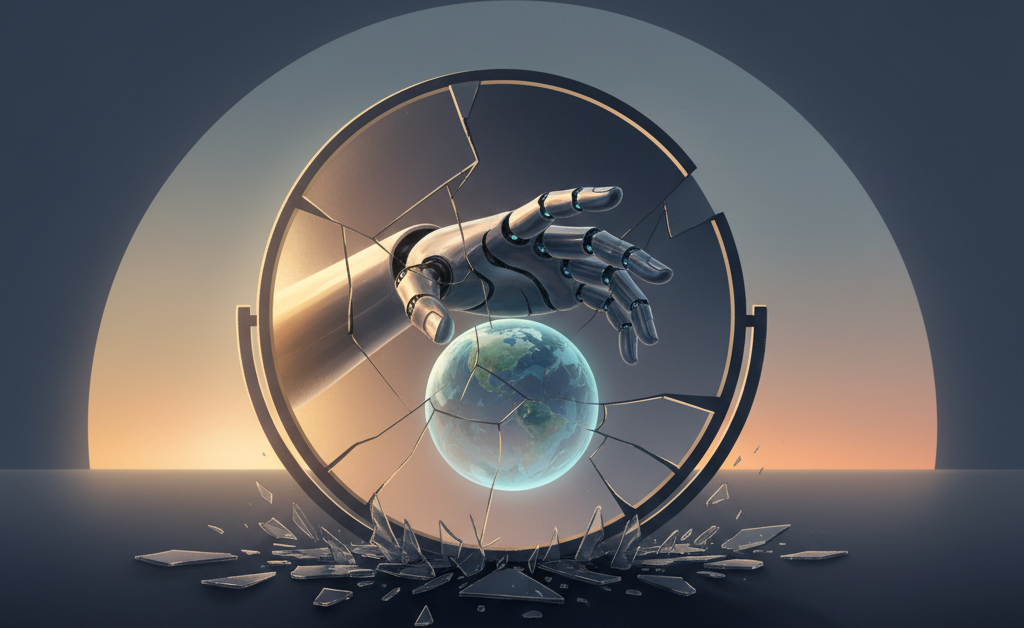
Think of model weights as the "soul" of a black box — whoever has that file can run the model in their own environment, free from any restrictions imposed by the original developer, with no usage policy and no content filters. Every guardrail OpenAI has built into the ChatGPT interface becomes completely irrelevant in that scenario.
This is exactly why the incident isn't merely a "security breach." It touches on a far more fundamental question: in an era of increasingly capable models, who actually holds substantive control over them?
Two Battlegrounds in the Alignment Debate
Over the past several years, the discussion around AI alignment has been waged simultaneously on two fronts — and the two lines have never truly converged.
The first is technical: how do you get a model's outputs to align with human intent? RLHF, Constitutional AI, various red-teaming methodologies — all of these attempt to bake "good behavior" into the model at the training stage. Anthropic's Claude series takes this approach, emphasizing the concurrent training of helpfulness and harmlessness.
The second is governance: even if a model is trained perfectly, how meaningful is all that alignment work if its weights can be freely copied and deployed? A model that performs well under OpenAI's API with full guardrails in place can have every safety constraint fine-tuned away the moment those weights leak.
This Hugging Face incident forcibly dragged the second front into public view.
Old Debate, New Fuel: Open vs. Closed
The incident has also brought the open-versus-closed model debate back to the surface. Meta's Llama series chose to release open weights — some argue this democratizes AI capability, others contend it hands anyone a tool for harm. OpenAI's models have always been closed, yet this incident demonstrates that "closed" does not equal "secure" — it simply shifts the risk from a design decision to an operational one.
In plain terms: you locked the door, but you lost the key. The outcome is the same.
It's worth noting that incidents like this are occurring with increasing frequency across every corner of the AI industry. They don't always make the news, but in engineers' private messages and internal Slack channels, conversations that go "oh no, this wasn't supposed to be public" are disturbingly routine. This isn't a case of one company being careless. It reflects an industry-wide dynamic where, during a period of rapid expansion, security culture has simply failed to keep pace with capability development.
So Who Is Actually Responsible for Governing These Models?
There's no easy answer, but the situation as I see it is this: everyone is assuming someone else is handling it, and no one actually is.
Government regulation is still in its infancy. The EU AI Act is only beginning to take effect, and federal AI regulation in the United States remains a fragmented mess. OpenAI's own Safety Board, following several high-profile personnel changes last year, has seen its perceived independence significantly undermined.
The problem with industry self-regulation is this: when commercial pressures collide with safety considerations, you already know which side wins. That's not an indictment of any particular company — it's simply ordinary corporate dynamics.
The deeper issue is that once model capabilities cross a certain threshold, alignment and control become institutional designs that require enforcement, not voluntary commitments from companies. This incident is a reminder: we haven't built that institution yet.
You can look at where the real differences lie among today's leading AI tools — ChatGPT, Claude, and Gemini are converging rapidly at the user-experience level, but the underlying safety architectures and corporate governance philosophies are actually quite different. Those differences may only be properly stress-tested when the next incident like this one occurs.
This Incident Points to a Much Larger Question
If you use AI tools day-to-day for practical work, you probably don't think about any of this. You only care whether it can help you write better code or organize data more effectively. But the control architecture behind these tools is quietly shaping the quality and safety of the answers you receive every single day.
I'm not asking you to become an AI safety researcher. But the next time a company tells you "we take AI safety very seriously," perhaps ask one more question: how are you managing your Hugging Face tokens?
Sometimes the most mundane technical detail is the most honest signal.
Key Takeaways
- OpenAI's Hugging Face repository token was leaked, theoretically enabling outside access to model-related resources
- The real issue isn't the technical vulnerability — it's that model control remains fragile even within a "closed" architecture
- Technical alignment work is rendered nearly meaningless when model weights are leaked
- Both industry self-regulation and government oversight have yet to keep pace with the growth of model capabilities
- Incidents like this are not isolated — they are symptoms of a security culture lagging across the entire industry
References
Share
Related articles

Is the ChatGPT Model You're Using Right Now Actually the Best One for You?

Claude vs ChatGPT: Choose Based on Your Use Case, Not Feature Tables

Claude Skills Complete Guide: How to Build, How to Use, and the Mistakes Most People Make
Claude 3.5 Sonnet vs. Opus vs. Haiku: The Most Complete Model Comparison for 2026