Ford's Reversal: Recalling Veteran Engineers — The One Thing AI Didn't Tell You
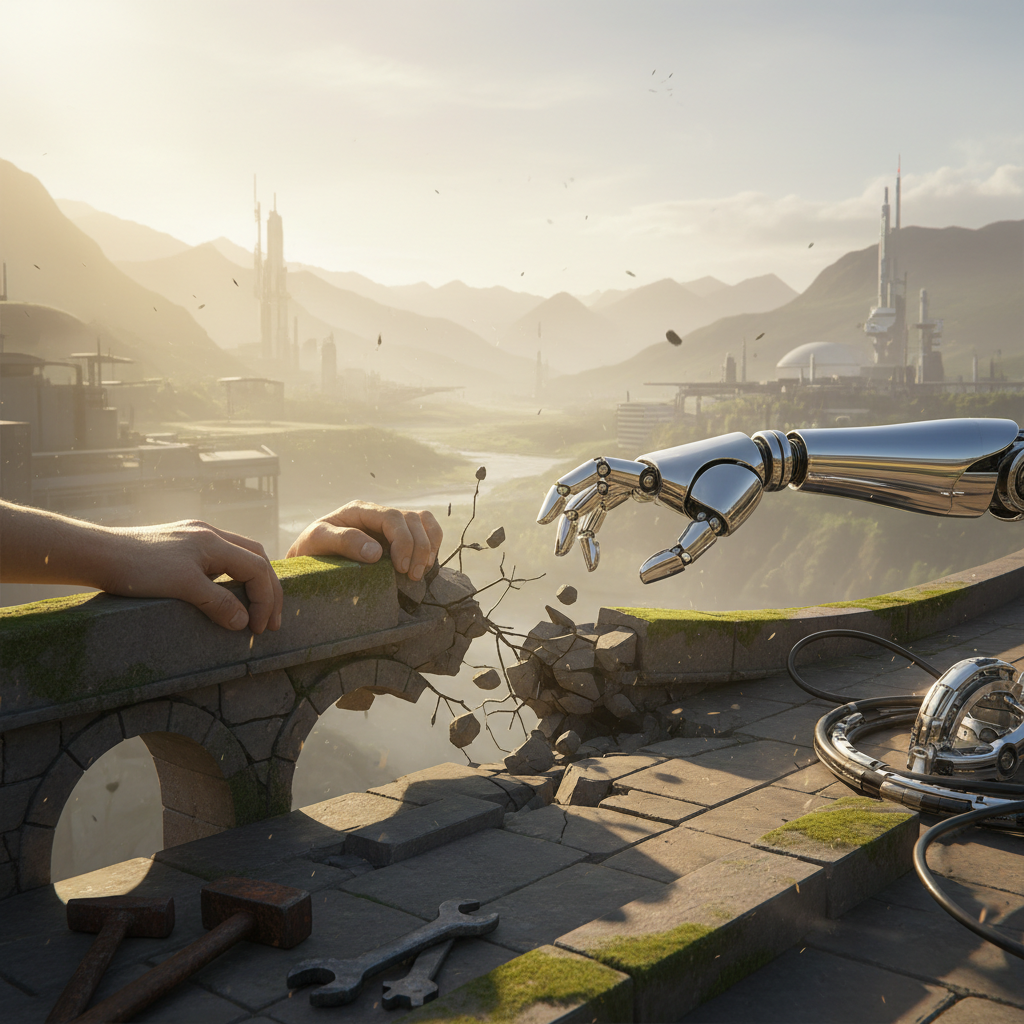
A Story That Makes Silicon Valley Uncomfortable
In the first half of 2026, a rather awkward story circulated through the automotive industry: after aggressively pursuing AI-driven automation in its production processes and attempting to replace human judgment with algorithms at scale, Ford quietly brought back a cohort of retired or departed senior engineers. These individuals earned an informal title — "gray beards" — referring to those veterans who had spent two or three decades on the factory floor, seasoned by experience and grease alike.
Ford's leadership acknowledged in internal communications: "We mistakenly believed that simply introducing artificial intelligence… would solve the problem." The sentence trailed off, but everyone understood what was left unsaid.
Where Does AI Actually Break Down on the Factory Floor?
This isn't a question of whether AI can be used — it's a question of where it's deployed and who oversees it.
A substantial portion of real-time judgment in manufacturing operates on what is known as tacit knowledge. What is tacit knowledge? It's the kind of understanding that can't be articulated, can't be written into a manual, yet allows a veteran engineer to hear a machine running and immediately know — "this one's about to go." That category of knowledge happens to be precisely what current language models and visual AI struggle most to handle.
AI excels at pattern recognition, data aggregation, and repetitive decision-making. It can detect surface defects in quality-control camera feeds; it can compute optimized routing in production schedules. But it cannot tell you that a parts supplier recently changed its raw materials, that a particular weld segment develops subtle deformations during colder seasons, or why the yield rate on a certain assembly line quietly drops 3% around shift changes.
That knowledge lives inside the heads of experienced engineers.
The "Replacement" Narrative Was Wrong From the Start
Over the past several years, "AI replacing human labor" became the standard frame for media coverage. That frame has some validity — repetitive, highly structured work is indeed disappearing rapidly — but it simultaneously created a dangerous illusion: that once AI is introduced, human judgment becomes superfluous.
Ford's case is the price of that illusion. According to international media reports, Ford significantly reduced its headcount of senior technical personnel on certain production lines, deploying AI systems to take over decision support. In the short term, the cost figures looked impressive. But problems began accumulating in the details. When product quality developed systemic issues that were difficult to localize, no one could quickly diagnose the root cause — because those minds were no longer in the room.
This is not a predicament unique to Ford. The same script has played out in various iterations across manufacturing, healthcare, legal support, and other verticals over the past two years. Ford is simply one of the rare cases willing to publicly acknowledge the failure and take corrective action.
What Can the Gray Beards Actually Do When They Return?
They didn't come back to shut down the AI systems. They came back to fill a new role: knowledge bridgers.
The core function of this role is to translate decades of accumulated tacit knowledge into formats that AI systems can learn from. More critically, they supply what might be called contextual judgment — when AI predictions contradict what's actually happening on the floor, senior engineers can determine which signal to trust.
This reveals a more mature model for AI adoption:
- AI handles the data-intensive perception layer: vast streams of sensor data, image recognition, anomaly alerts
- Senior personnel handle the contextual interpretation layer: reading the signals AI surfaces, determining action priorities
- The organization maintains a knowledge extraction process: creating structured pathways for veteran engineers' decision-making logic to be codified and passed on
It's not a particularly romantic story, but it is far more realistic than "AI handles everything."
Why This Story Matters to Every Working Professional
After years of observing the AI industry, I've noticed an interesting pattern: the people most anxious about AI displacement are often not those most likely to be displaced — they're the ones who have accumulated deep domain knowledge within their organizations but haven't yet had the opportunity to demonstrate its value.
Ford's case offers an unlikely source of confidence: the judgment you've developed by staying in a field long enough, by falling into enough traps, is not something a large language model can replicate in the short term simply by ingesting more data.
That said, this is not a call for complacency. Those gray beard engineers were recalled because their knowledge had a clearly defined use case and quantifiable business value. If someone within an organization is merely executing processes rather than understanding them, the pressure AI creates is entirely real.
The distinction comes down to this: are you surviving on process, or on judgment?
An Experiment That Isn't Over
Ford's story has no final chapter yet. Their current approach involves building an iterative mechanism between AI systems and senior engineers — an attempt to convert tacit knowledge into training data, so that the next generation of systems develops a better fluency in the language of the shop floor.
The direction is right. But it is also profoundly time-consuming. The extraction and transmission of knowledge has never been a process that scales quickly.
I'll continue following this case. If Ford manages to operationalize this human-machine collaboration model, it will stand as one of the most instructive examples of AI adoption in manufacturing. If it fails, it will be yet another lesson — the lesson about how severely the phrase "AI transformation" has been overused.
Either way, the image of those gray beard engineers walking back onto the production line says something more honest than any AI product launch ever could: wherever the boundaries of technology lie, that is precisely where the human role begins.
Share
Related articles

Is the ChatGPT Model You're Using Right Now Actually the Best One for You?

Claude vs ChatGPT: Choose Based on Your Use Case, Not Feature Tables

Claude Skills Complete Guide: How to Build, How to Use, and the Mistakes Most People Make
Claude 3.5 Sonnet vs. Opus vs. Haiku: The Most Complete Model Comparison for 2026