Rivals Unite: Apple's New AI Architecture Runs on Google Gemini — and This Is No Mistake
Wait, This Isn't Clickbait
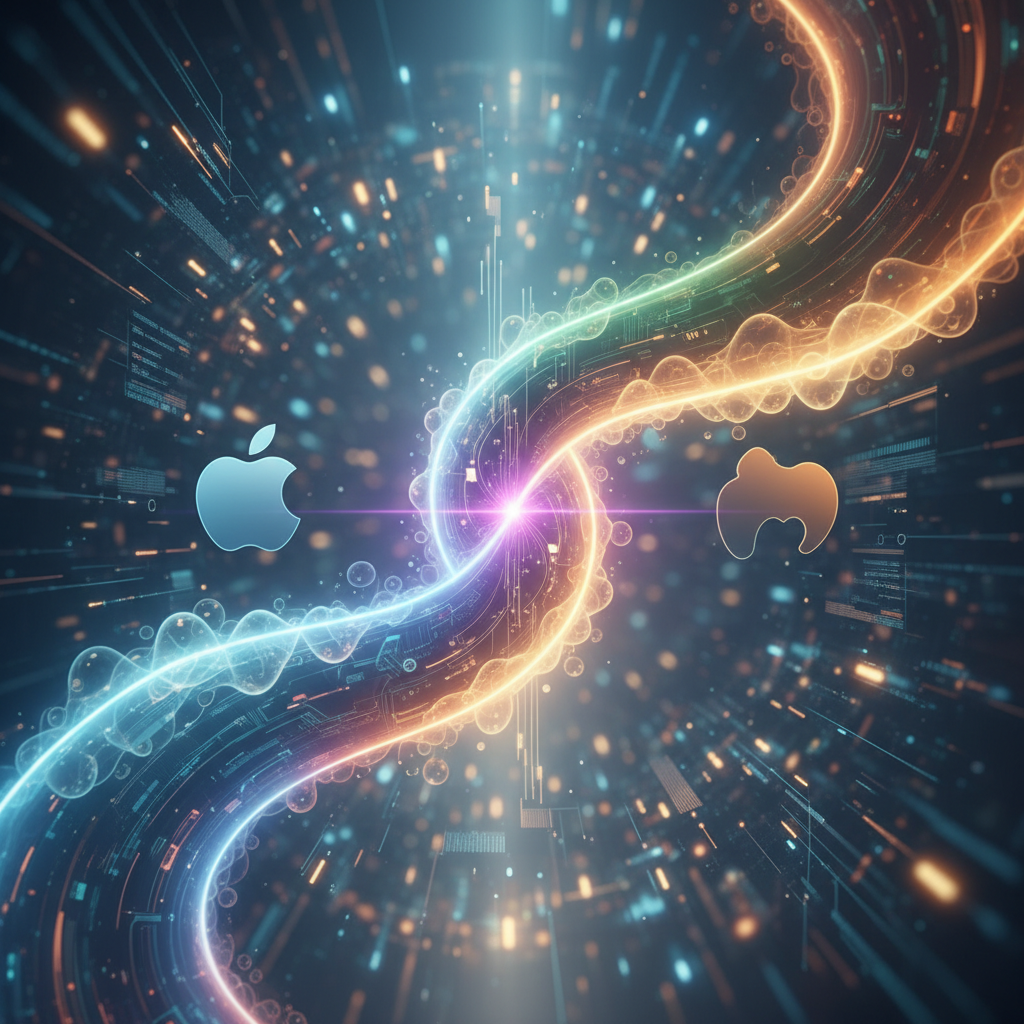
Just 48 hours ago, MacRumors published a story that brought the tech world to a collective standstill: Apple has officially revealed its next-generation AI architecture — and the underlying model powering it is Google Gemini. Not OpenAI. Not Apple's own Intelligence models going it alone. Google. The same Google that has been locked in a two-decade battle with Apple over browsers, search, and mobile ecosystems.
My first reaction, honestly, was to wonder whether I'd clicked on a fake news article. But on closer inspection, not only is this real — the logic behind it is far more compelling than it appears on the surface.
What Is Apple Calculating Here?
Some context first. Since Apple Intelligence was announced at WWDC 2024, criticism has never let up: delayed features, restricted regional rollouts, a visible gap between marketing promises and real-world performance. Compared to Google Gemini's rapid advances in multimodal understanding, long-context processing, and language reasoning, the shortcomings of Apple's in-house models have become increasingly difficult to conceal.
The decision to place Gemini at the core of this architecture isn't hard to understand: use the best components available, rather than insisting on a fully in-house stack. This is a victory for pragmatism — and an extension of the "supply chain thinking" that has defined the Tim Cook era into the realm of AI. Just as iPhones run TSMC chips and Sony image sensors, Apple has never made everything itself; it's simply very good at making people think it does.
It's worth noting this is not Apple's first external AI partnership. Last year's integration with OpenAI set a precedent, with Siri handing off certain queries to ChatGPT. But that integration felt more like "borrowing someone for the front desk." Gemini's role this time appears to go much deeper into the underlying architecture — a fundamentally different proposition.
And What Does Google Get?
There's a power dynamic here that deserves a closer look.
Google pays Apple roughly $20 billion a year just to remain the default search engine in Safari. That sum has long been viewed as Google's "protection money" for access to Apple's ecosystem, and a significant pillar of Apple's services revenue. Now, with Gemini embedded in the core computational layer of Apple devices, Google occupies a deeper position in the digital lives of Apple users than ever before.
From Google's perspective, this is a landmark moment in the commercialization of the Gemini model. Getting into the AI inference pipeline of over two billion Apple devices worldwide — that's a level of exposure and usage volume no advertising spend could buy. More importantly, it gives Gemini access to a massive loop of real-world inference data and user feedback. In the AI arms race, that is a more valuable asset than any quarterly earnings report.
It's Time to Retire the "Rivals" Framework
Tech media loves to describe Apple and Google as sworn enemies. It's a compelling narrative — but it stopped being accurate a long time ago. The reality is that these two companies have always maintained a deeply symbiotic commercial relationship alongside their competition. Google is one of Apple's largest advertising clients; Apple's hardware sales are partly dependent on the seamless experience Google's services provide.
The AI era has simply made this complex relationship more visible. When the capability gap between models is wide enough, and user expectations for AI experiences are high enough, no company can afford to spend too much time on ideological purity.
A useful comparison: Meta chose to open-source the LLaMA series, betting on ecosystem advantages over technical moats; Microsoft went all-in on OpenAI; Amazon builds its own Titan models while welcoming a broad range of third-party options. Every company is answering the same question in its own way: In an era of rapidly converging AI capabilities, where do you dig your moat?
Apple's answer seems to be: dig it in hardware integration, privacy architecture, and user trust — and for the underlying model, just use the best one available.
Will the Privacy Promise Start to Slip?
This is the dimension I'm watching most closely.
Apple has long positioned "privacy" as a core brand differentiator, and its Private Cloud Compute architecture was designed to ensure that sensitive inference never leaves Apple-controlled environments. But with Gemini embedded in the underlying architecture, the boundaries of data processing become complicated: Which inference tasks run locally? Which go to Apple's private cloud? And which traffic ultimately touches Google's infrastructure?
The information publicly available today is insufficient to fully answer these questions — but they will be the central issues that tech journalists and privacy advocates continue to press. Apple needs to provide more concrete technical explanations than "we take your privacy very seriously," or this integration will become a trust deficit that keeps quietly growing.
A Final Word from the Observer
What's most worth remembering about this story may not be the dramatic fact that "Apple is using Google" — it's what it reveals about the logic of the AI industry: In this era, even the most closed ecosystems cannot be entirely self-sufficient. The competition over foundation model capabilities is forcing every company to redraw the line between what is "ours" and what is "borrowed."
The story of rival giants joining forces isn't over. The chapters ahead are worth watching closely.
Share
Related articles

Is the ChatGPT Model You're Using Right Now Actually the Best One for You?

Claude vs ChatGPT: Choose Based on Your Use Case, Not Feature Tables

Claude Skills Complete Guide: How to Build, How to Use, and the Mistakes Most People Make

Claude 3.5 Sonnet vs. Opus vs. Haiku: The Most Complete Model Comparison for 2026