The Powder Keg of AI Layoffs: When Unemployment Outpaces Transition, Society Pays the Price
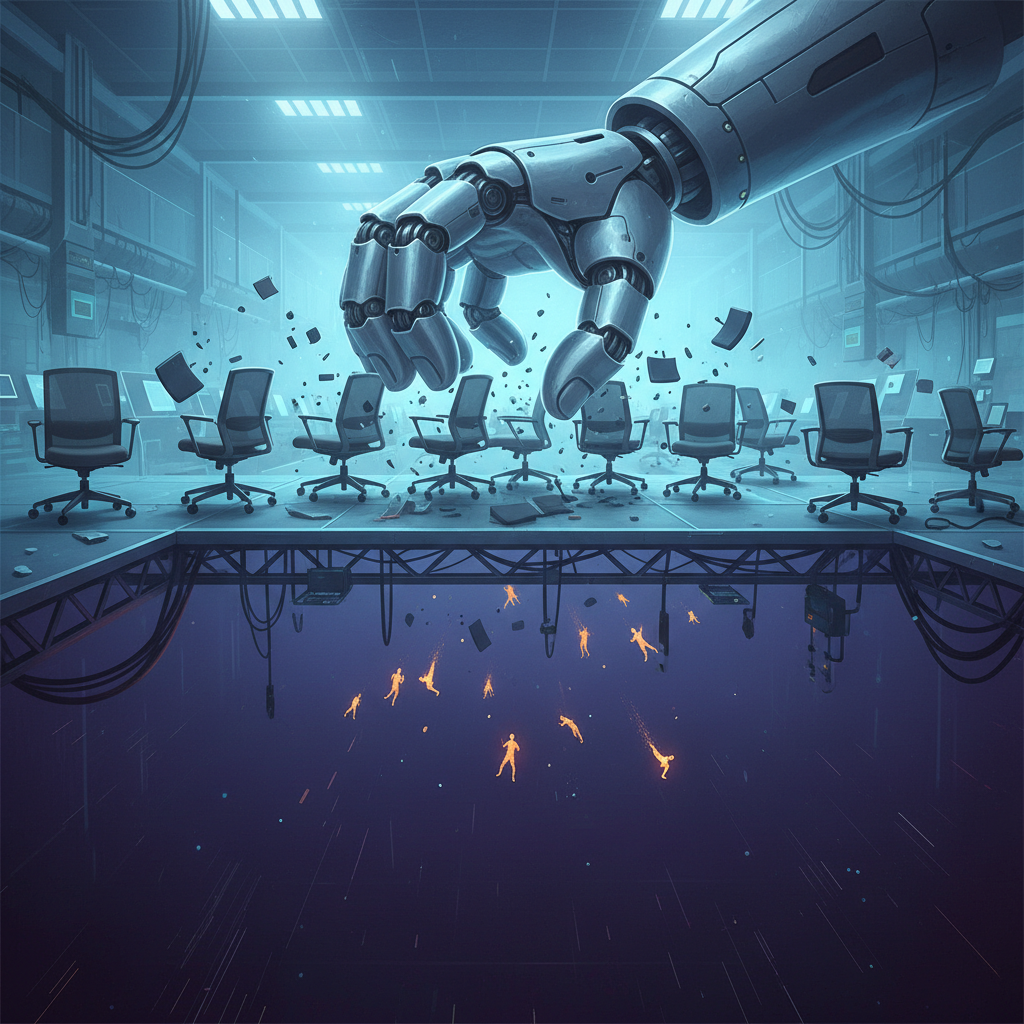
Signals Within 48 Hours: Layoff Numbers Hit New Highs
Over the past two days, the density of layoff news in the tech industry has been unusually concentrated. According to real-time tracking by Layoffs.fyi, more than 170,000 tech employees have been laid off so far in 2025, with multiple reports directly identifying AI automation as one of the primary drivers — no longer a "possibility," but something "actively happening." SAP, Dell, Cisco, IBM — these established tech giants are cutting thousands at a time, while simultaneously announcing hundreds of millions of dollars in AI infrastructure investments.
This contrast itself is the fuse on the powder keg.
What Makes This Wave of Layoffs Especially Dangerous: The Time Gap
Every previous wave of technological disruption — from the Industrial Revolution to the post-dot-com bust restructuring — followed a common pattern: destruction came first, opportunity arrived later, and in between was a transitional period that people simply had to endure. The problem this time is that the transitional period is being compressed to near nonexistence.
McKinsey's report this year estimates that by 2030, some 300 million jobs globally will be "substantially affected" by AI automation — and that euphemistic phrase "affected" in practice often simply means "eliminated." Meanwhile, the retraining resources available to these displaced workers — government policy, corporate training programs, career transition platforms — are nowhere near keeping pace.
I've observed this industry long enough to offer a rather harsh reality check: the iteration cycle of AI tools is measured in months, but the cycle of human skill transformation is measured in years. This misalignment is the core reason social pressure is beginning to accumulate.
Not Just Tech: The Collective Anxiety of White-Collar Workers
What is most unsettling about this wave of layoffs is that it has broken through the boundaries of past "disaster zones." Software engineers, data analysts, legal assistants, financial auditors, marketing copywriters — positions once considered to require a high degree of professional judgment and difficult to automate — are being steadily infiltrated by AI tools one by one.
According to Goldman Sachs Research, approximately 25% of work tasks in the United States are technically "replaceable by AI," with the figure closer to 35% in Europe. These numbers are not doomsday prophecies — they are descriptions of the current capability boundaries of tools already in use.
Even more noteworthy is the emotional contagion effect. Discussions about "career anxiety" and "AI replacement" on LinkedIn doubled in the past quarter, with large numbers of workers who have not been laid off beginning to feel a sense of uncertainty hanging over their heads — How much longer do I have? Who's next in line?
This anxiety itself is already a social cost.
The Dual Signal from Corporations Only Complicates Things
In observing corporate PR operations, I've noticed an increasingly common pattern: the left hand issues layoff notices while the right hand announces AI investment plans. This approach may stabilize stock prices in the short term, but the psychological signal it sends to internal employees and external job seekers is devastating.
How do you tell an engineer who was just laid off, "AI is an opportunity — go reinvent yourself"? When a company simultaneously announces 3,000 layoffs and a $200 million investment in AI systems, the message is practically plain-spoken: we chose machines over you.
Some companies have tried to soften the blow with talk of "redeployment," but according to tracking data from Challenger, Gray & Christmas, the proportion of employees successfully transitioned to internal roles does not exceed 15%. The remaining 85% enter a job market already heavily saturated with AI-generated resumes and AI screening systems — and they must use their own résumés to compete against AI. The absurdity of that situation speaks for itself.
Policy: The Slowest Link in the Chain
The speed of government response on this issue is particularly alarming.
The United States currently has virtually no specific legislative protections against AI-driven layoffs. The EU's AI Act focuses on risk classification and transparency requirements, with compensation mechanisms for employment impact still conspicuously absent. Taiwan's labor regulations, meanwhile, contain vast gray areas in how "automation-induced layoffs" are defined and what compensation standards apply.
This means that when companies replace human workers with AI, the existing legal framework offers workers almost no additional buffer. Severance formulas, notice period calculations — these are tools designed for "traditional layoffs." Faced with the new phenomenon of "AI-driven systemic replacement," they are essentially old swords against new monsters.
The Powder Keg Won't Necessarily Explode Right Away, But Pressure Is Building
I don't believe this wave of AI layoffs will trigger a large-scale backlash akin to the Luddite movement in the near term — at least, there are no signs of that at the moment. What concerns me far more is a prolonged, slow-burning erosion of social sentiment: the collapse of trust in the tech industry, a collective aversion to the narrative that "AI is a good thing," and a decline in consumer confidence in the market's future.
These are all quantifiable costs — they're just being obscured right now by stock market figures.
When jobs disappear faster than people can transition, society's compensatory mechanisms begin to fail. This is not a technological problem — it is a political question about how we choose to distribute the dividends of AI. And the current answer, evidently, is far from satisfactory.
Share
Related articles

Is the ChatGPT Model You're Using Right Now Actually the Best One for You?

Claude vs ChatGPT: Choose Based on Your Use Case, Not Feature Tables

Claude Skills Complete Guide: How to Build, How to Use, and the Mistakes Most People Make
Claude 3.5 Sonnet vs. Opus vs. Haiku: The Most Complete Model Comparison for 2026