You Think AI's Biggest Threat Is Stealing Jobs? That Worry Might Be Pointing in the Wrong Direction

The Threat Everyone Worries About Isn't Necessarily the Most Dangerous One
Whenever an AI-related survey is published, "job loss" almost invariably tops the list. A 2023 McKinsey report estimated that up to 300 million jobs worldwide could be impacted by automation by 2030; the World Economic Forum's figures are slightly more optimistic, but point equally toward structural transformation.
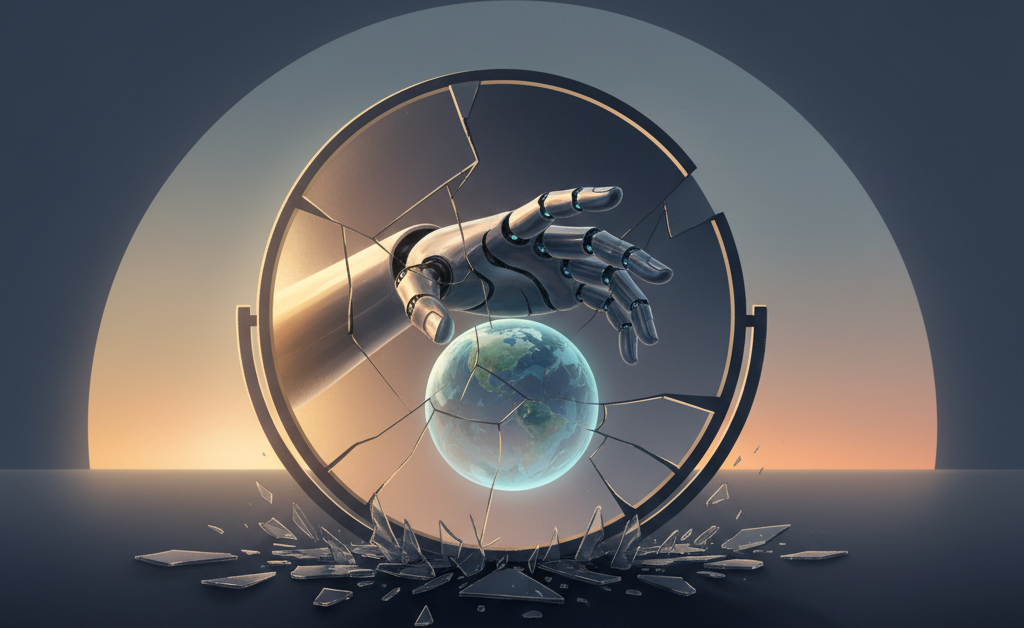
These numbers aren't wrong, but I've always felt the "AI stealing jobs" framing directs public attention toward a relatively visible, measurable dimension — while overlooking a far less perceptible and ultimately more destructive threat: generative AI is systematically eroding humanity's capacity to perceive what is "correct."
Fluency Is a Double-Edged Sword
Let me be precise about the mechanism behind this threat.
The core capability of LLMs (large language models) is generating "the next most statistically plausible word." This mechanism makes their output extraordinarily fluent — tonally consistent, structurally coherent, and often carrying an academic register. The problem is that fluency is automatically interpreted by human cognition as a proxy for credibility.
There is a psychological phenomenon known as the "Processing Fluency Effect": information that the brain processes more easily is more readily judged to be true. When a model outputs a piece of incorrect medical advice in a perfectly logical structure, most non-specialist readers won't question it — because it "reads too right."
This isn't a hypothetical risk. A 2023 study published in JAMA Internal Medicine found that when ChatGPT answered common patient health questions, a significant proportion of its responses contained "concerningly inaccurate information" — yet the tone and format of those responses led participants to trust the AI more than they trusted real physicians.
A New Form of Error: Not Obvious, but Overconfident
Traditional misinformation is easy to spot — strange punctuation, aggressive tone, unclear sourcing. The errors AI produces trend in the opposite direction: they are gentle, neutral, properly formatted with citations, and occasionally even come with an appropriate "this is a complex issue" disclaimer.
I've observed a deeply unsettling pattern: some users, after working with AI tools for a period of time, begin using "the AI said so too" as a conversation-ending argument. When AI output assumes the role of arbiter rather than assistant, the chain of knowledge verification breaks down entirely.
This problem is especially acute in three domains: law, medicine, and finance. These are all fields where being slightly off can cause catastrophic harm, and AI's current hallucination problem — where models output incorrect facts with high confidence — is precisely hardest for non-specialists to detect in these high-stakes contexts.
The Problem Isn't the Model — It's How It's Deployed
I want to draw a distinction that is frequently misunderstood: the root of this threat does not lie entirely with the model itself; to a greater extent, it stems from deployment context and a lack of user education.
GPT-4, Claude 3, and Gemini Ultra all incorporate uncertainty-expression mechanisms to varying degrees by design — they can say "I'm not sure." But product-layer design often incentivizes confident responses, because that's what scores higher in user experience ratings. Users want answers, not hesitation.
When commercial logic drives models toward "appearing more certain" rather than "actually being more accurate," we have buried a cognitive time bomb inside everyday workflows.
The Underestimated Long-Term Effect
The deeper issue operates on a temporal dimension.
If people live for extended periods within an information environment increasingly filled by AI-assisted output, the muscles of critical reading and fact-checking may gradually atrophy. This isn't science fiction — Google's own research long ago demonstrated that after navigation apps became widespread, human spatial memory capabilities declined on average. When tools substitute for cognitive tasks, they don't merely improve efficiency; they also reshape how frequently different parts of the brain are exercised.
I'm not arguing that we should stop using AI — that position is neither realistic nor meaningful in 2025. But what is urgently needed right now is to treat the "AI credibility illusion" as a policy issue every bit as serious as "AI-driven unemployment":
- Are education systems training students to recognize the potential errors embedded in AI-generated content?
- Do organizations have clear AI output review processes in place, rather than simply using AI to accelerate content production?
- Do regulatory frameworks require AI systems deployed in high-risk domains to disclose uncertainty ranges?
Closing: The Threat Is Not Replacement — It's Assimilation
Job theft is an external threat — you can see it, resist it, retrain for it, legislate against it.
But when the output logic of AI gradually seeps into human judgment frameworks — when we begin evaluating what counts as a "credible answer" by the standard of "AI's tone of certainty" — that threat is internal, and far harder to reverse.
This, in my view, is the generative AI threat most deserving of serious attention. Not that it replaces us, but that we imperceptibly begin letting it define what "correct" means.
Share
Related articles

Is the ChatGPT Model You're Using Right Now Actually the Best One for You?

Claude vs ChatGPT: Choose Based on Your Use Case, Not Feature Tables

Claude Skills Complete Guide: How to Build, How to Use, and the Mistakes Most People Make
Claude 3.5 Sonnet vs. Opus vs. Haiku: The Most Complete Model Comparison for 2026